Isopods: From Woodlice to Deep-Sea Giants (And Why They're Conquering Aquariums, Too)
Valerio ChiaradonnaIf I say isopods , you might not think of anything. But as soon as I mention "woodlice," those little gray creatures you find under plant pots that roll up into balls, you immediately understand what we're talking about. Isopods, in fact, are a fascinating and surprisingly diverse group of crustaceans: there are thousands of species, from tiny and discreet to deep-sea giants that seem to have stepped out of a science fiction film.
In this article, you'll discover who they are, where they live, their most curious varieties, and why they're becoming popular in aquariums and terrariums today.
Who are isopods?
Isopods belong to the order Isopoda , which includes over 10,000 known species . Their name means "equal feet," because unlike other crustaceans (such as shrimp or crabs), they have very similar legs.
Main features:
- Segmented exoskeleton that protects the body.
- All identical paws used for walking.
- They breathe with modified gills , which is why even terrestrial ones need humid environments.
- Varied diet , from the decomposition of organic matter to parasitism.
Where do isopods live?
Their ability to adapt is incredible. They are found practically everywhere:
🌊 Marine environments → from the ocean depths to the coasts. Here we also find the famous giant isopods (Bathynomus giganteus), which can exceed 40 cm.
🏞 Freshwater → some species live in rivers and lakes.
🌱 Land → Woodlice (Armadillidium, Oniscus, Porcellio) are the only crustaceans fully adapted to terrestrial life. They prefer moist environments, under rocks and logs, where they recycle dead leaves and debris.
Most well-known and curious varieties
🔹 Armadillidium vulgare – the classic “woodlice” that rolls up into a ball to defend itself.
🔹Armadillidium gestroi It is characterized by its clearly defined intense yellow spots and large size.
🔹Armadillidium klugii Montenegro is among the most popular and colorful woodlice species, adults reaching sizes of up to 1.5 cm.
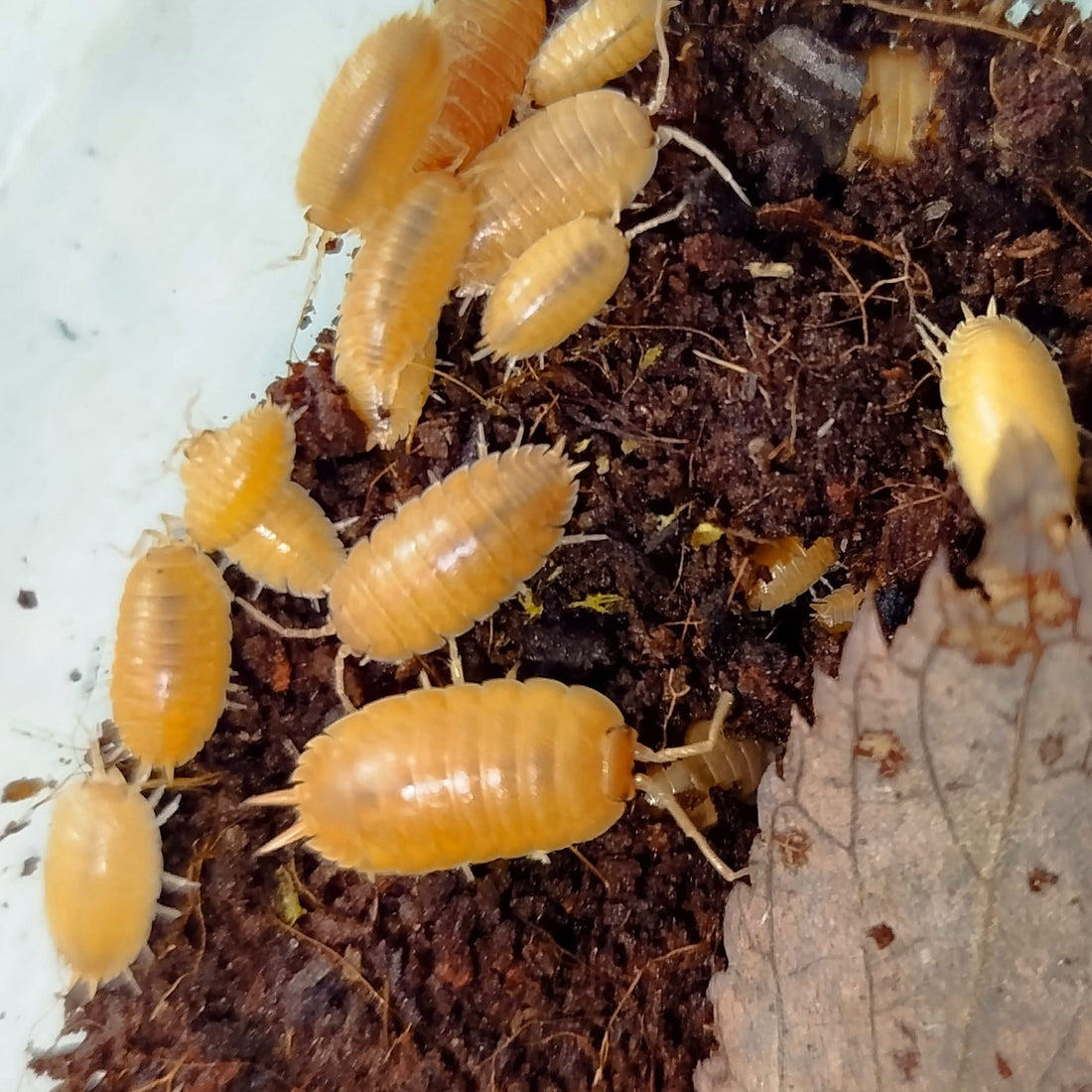
🔹 Armadillidium vulgare Magic Potion The "magic potion" mutation is the Dalmatian gene expressed in A. vulgare. Vulgares naturally have yellow spots present in the wild.
🔹Cubaris Panda King is one of the most beautiful and rare species of isopods, easy to manage among the Cubaris genus, adults reach dimensions of up to 1.2cm
🔹Porcellio leavis Orange is a lively and hardy ornamental isopod, ideal for bioactive terrariums and perfect for exotic animal enthusiasts
🔹 Porcellio scaber – similar, but does not roll up completely: it remains more “wrinkled”.
🔹 Bathynomus giganteus – the colossus of the deep, which can reach impressive dimensions.
🔹 Cymothoa exigua – the parasitic isopod that replaces the tongue of fish, feeding on their blood and occupying their space (one of nature's most disturbing oddities!).
🔹 Cubaris sp. “Panda King” – highly sought-after in terrariums, with a spectacular black and white coloration.
DISCOVER ALL THE AVAILABLE SPECIES BY CLICKING HERE
Why are isopods important?
Isopods play a fundamental role in ecosystems:
- Natural recyclers : they transform dry leaves, decaying wood and organic waste into useful substances for the soil.
- Food chain : They are food for many animals, from birds to reptiles.
- Parasites : Some species control fish populations, albeit in a “crude” way.
In practice, without them, nature would have more difficulty managing biological waste.
Isopods in aquariums and terrariums
In recent years, isopods have been experiencing a real boom in aquarium and terrarium keeping .
🐠 In the aquarium
- Some marine isopods enter as unwanted guests , especially in marine tanks: they can feed on small fish or become parasites.
- Conversely, in freshwater ponds and paludariums, some detritivorous species are introduced as “cleanup crews” , useful for disposing of food scraps and dead leaves.
🌱 In the terrarium
Here are the real protagonists:
- Terrestrial isopods are kept as clean-up crew in tropical terrariums, along with springtails.
- They keep the substrate healthy and clean, consuming mold and organic waste.
- There are varieties bred as a hobby, such as the aforementioned Cubaris “Panda King” or the colourful Porcellio laevis “Dairy Cow” , which have black and white spots similar to those of cows.
Basically, they are like a small natural maintenance team that works for free in your terrarium.
Giant Isopods: Thrilling Facts
We can't close without mentioning the real monsters of the group: the giant isopods.
They live in the deep, where pressure is extremely high and food is scarce. They can go months without eating, and when they find a carcass (of a fish or even a whale), they feed on it until they burst.
A Bathynomus giganteus found in captivity fasted for five years without dying: living proof of their incredible endurance.
Isopods are much more than just "little gray critters under pots": they are ancient, adaptable crustaceans that are incredibly useful to ecosystems. From nature to our aquarium or terrarium, their role remains the same: recycling, cleaning, and maintaining balance .
If you happen to see one, don't squash it: think of it as observing a little engineer of nature working to keep the world cleaner.
If you are unsure which product is right for you, Write us on WhatsApp or stop by the store : our team is available to give you the best advice.
📍 Where to find us
Animal Instinct Rome
For more details and to purchase products:
Via di Monte Verde, 2, 00152
Telephone: 06 87691 933
Mobile: 338 838 1624
Discover all our available items on our website www.animal-instinct.it
