Meerkat: The Little Desert Sentinel Who Conquers Everyone
Valerio ChiaradonnaThe meerkat ( Suricata suricatta ) is a mammal belonging to the mongoose family, famous throughout the world for its upright posture and fascinating social behavior. Native to the arid regions of southern Africa, this animal has adapted to a challenging environment thanks to group cooperation and extraordinary survival strategies.
If you're looking for information on where meerkats live, what they eat, and how they behave in the wild , you're in the right place: in this article, we'll explore in detail everything that makes this little "guardian of the desert" unique.
Physical characteristics of the meerkat
The meerkat is a small animal, but with great charisma.
Size : The body measures between 25 and 35 cm, while the tail can reach 25 cm.
Weight : Varies between 600 grams and 1 kg, making it light and agile.
Coat : The fur is grayish-brown with darker streaks on the back. Each meerkat has a unique pattern, like a fingerprint.
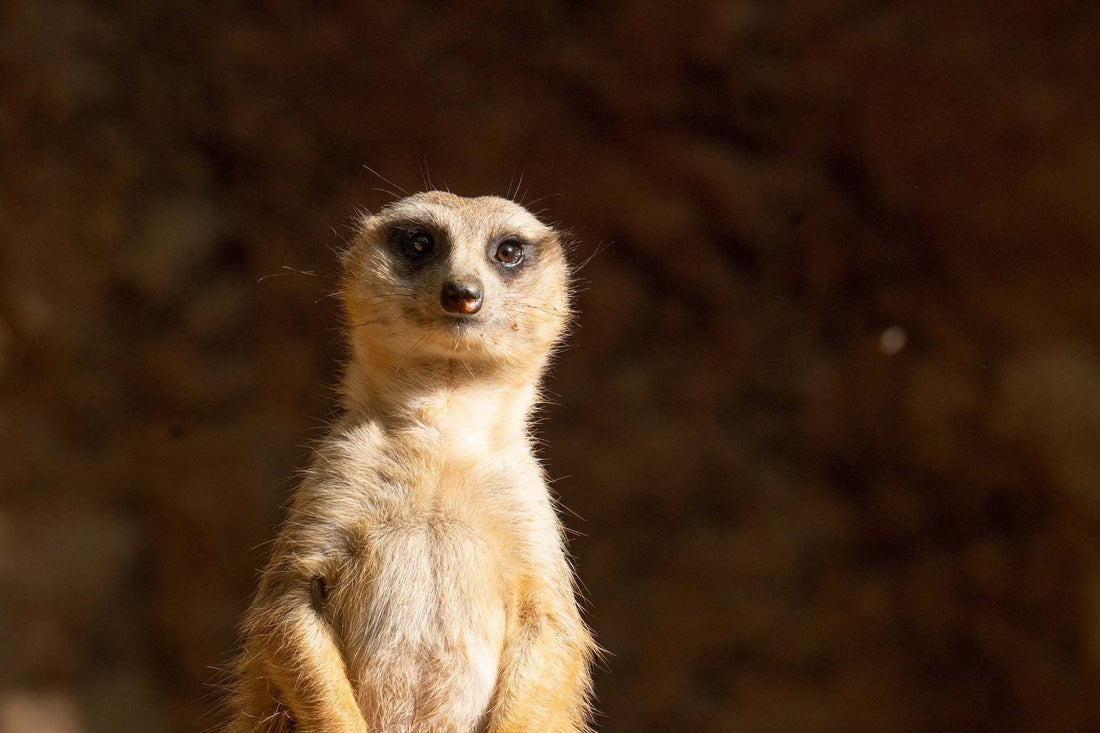
Large eyes : circled in black, they help reduce glare from the sun.
Upright posture : Using their tail as a balance, meerkats stand on their hind legs to scan their surroundings.
👉 This characteristic has made the meerkat a much-loved animal by the general public, also thanks to its representation in animated films such as The Lion King .
Habitat and distribution
The meerkat lives mainly in the arid and semi-desert areas of southern Africa:
- Kalahari Desert
- Namibia
- Botswana
- South Africa
- Angola
In these areas, characterized by temperature fluctuations between day and night, meerkats have developed highly complex underground burrows, with multiple entrances and internal chambers. The burrows allow the group to shelter from the heat and predators, maintaining a more stable temperature.
Social life: a group animal
The most fascinating feature of the meerkat is its social organization .
Meerkats live in clans that can number up to 30-50 individuals.
Each group is led by a dominant female , the only one allowed to reproduce.
Group life is based on cooperation: there are sentries who monitor the territory, diggers who expand the burrows and even “babysitters” who look after the cubs.
📢 Meerkats' vocal calls are incredibly sophisticated: there are different signals to warn of the presence of eagles, snakes, or jackals.
Meerkat feeding
The meerkat is an omnivorous animal with a strong insectivorous tendency .
Main food : insects, scorpions, millipedes, and spiders.
Other foods : small reptiles, birds, eggs, tubers and roots.
Hunting strategy : each individual searches for food alone, but always close to the group.
Fun fact : Meerkats are able to eat scorpions after removing their stingers, a skill they also teach their pups.
Another peculiarity of theirs is that they obtain most of the necessary fluids from their diet itself , reducing the need to drink water in desert environments.
Reproduction and care of young
- Gestation lasts approximately 70-80 days .
- Each litter produces 2-5 pups .
- After weaning, the young are raised collectively by the entire clan: not only the parents, but also siblings and uncles take care of the newborns.
- Puppies begin to participate in group activities in the first few weeks of life, learning hunting techniques and social behavior from their elders.
Longevity and state of conservation
In the wild, meerkats live an average of 6-10 years .
In captivity, thanks to protected conditions, they can reach 15 years .
The species is currently classified as “Least Concern” by the IUCN, thanks to its wide distribution and ability to adapt.
The main threats are habitat loss and natural predators, such as birds of prey and carnivores.
Curiosities about the meerkat
Meerkats have more than 20 different vocalizations to communicate.
Despite their small size, they can even tackle poisonous snakes thanks to their agility.
They are diurnal animals: they spend the hottest hours in their dens and feed in the morning and late afternoon.
Each clan can have more than 15 different lairs and move between them regularly.
The meerkat is much more than a curious little mammal: it is a symbol of cooperation, adaptability, and social intelligence. Its ability to live in groups and face the challenges of the desert together makes it a unique and fascinating animal.
Whether you're an exotic animal enthusiast or simply curious to learn more about the "sentinel of the desert," the meerkat proves that community strength can make a difference, even in the heart of the planet's most hostile environments.